
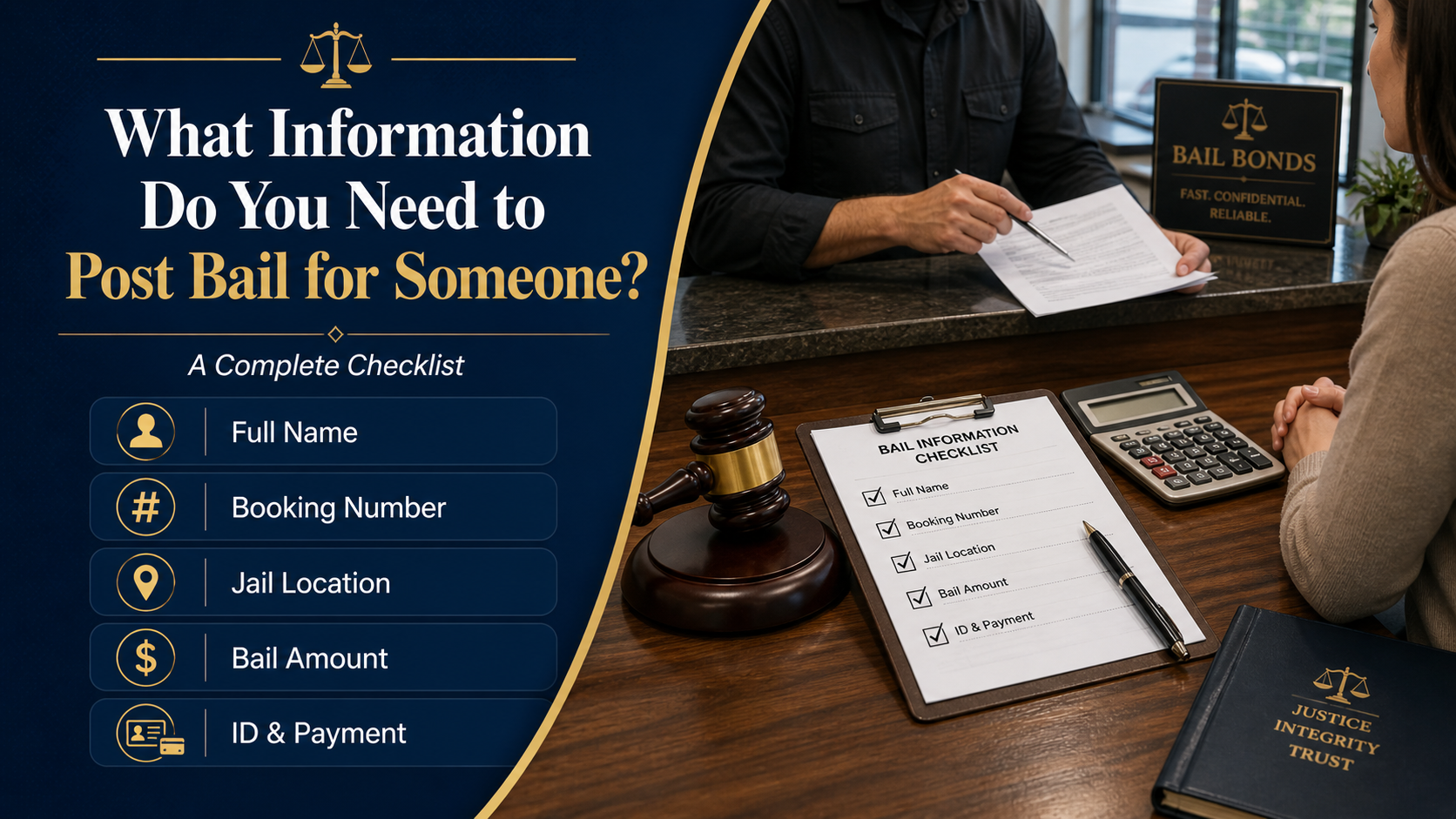
Outcome: By following this comprehensive guide, you will successfully gather all the required information and documents to post bail for someone within 2-4 hours. This process requires moderate organizational skills and basic financial knowledge.
Before You Begin: Essential Prerequisites

Prerequisites Checklist
- Understand bail types: Cash bail, surety bond, property bond, or release on recognizance
- Financial readiness: Access to 10-15% of total bail amount for bail premium (non-refundable)
- Location information: Know which jail, detention center, or courthouse holds the defendant
- Time availability: Allocate 2-4 hours for the bail posting process
- Legal understanding: Recognize your liability as cosigner or indemnitor
- Contact information: Have bail bond company phone numbers ready
The bail posting process involves coordination between multiple parties including the defendant, bail bondsman, court, and often family members. Understanding bail bond requirements before beginning ensures a smoother pretrial release process.
Step 1: Gather Critical Defendant Information and Arrest Details
Contact the jail or detention center immediately to obtain essential arrest information. The booking officer can provide most of these details within 15-30 minutes of your call.
Required Defendant Details
| Information Category | Specific Details Needed | Where to Obtain |
|---|---|---|
| Personal identification | Full legal name, date of birth, social security number | Defendant or booking officer |
| Booking details | Booking number, case number, arrest date | Sheriff’s office or police department |
| Criminal charges | Offense description, charge classification (felony/misdemeanor) | Arresting agency or clerk of court |
| Arrest location | Specific jail facility, address, housing unit | Law enforcement or detention center |
| Bail amount | Total bail set by judge or bail schedule | Magistrate, arraignment court, or courthouse |
Action item: Call the detention facility using the defendant’s full legal name and approximate arrest date. Request the booking number immediately, as this expedites all subsequent steps in the bail posting checklist.
Understanding Court Information Needed to Post Bail
Document the following:
- Court jurisdiction: Municipal court, district court, or state court
- Next court date and mandatory appearance time
- Judge or magistrate name assigned to the criminal case
- Courtroom number or location within the courthouse
- Case docket number from the clerk of court
Step 2: Compile Personal Identification and Documentation
Bail bond companies require extensive identification documents from both the defendant and the cosigner. Unlike cash bail, which only requires payment, surety bonds demand thorough background verification.
Cosigner Information and Indemnitor Requirements
As the indemnitor, you assume legal obligations and financial responsibility. Prepare the identification needed to post bail:
- Government-issued photo ID: Valid driver’s license, passport, or state identification card
- Social Security card: Original or certified copy for Social Security Administration verification
- Proof of residence: Recent utility bills (electric, gas, water), lease agreement, or mortgage documents dated within 60 days
- Current address verification: Two separate documents confirming your residence
- Contact information: Primary phone number, secondary emergency contacts, and email address
The bail bond agent will verify your identity through multiple databases.
Employment Verification and Income Documentation
Financial guarantee requirements include proof of stable employment and sufficient income. Gather these employment verification documents:
- Employer information including company name, address, and supervisor contact
- Recent pay stubs covering the last 30-60 days
- Income verification letter on company letterhead
- Tax returns for self-employed indemnitors
- Bank statements showing regular deposits (last 2-3 months)
Step 3: Prepare Financial Documentation and Collateral Requirements
The bail bondsman needs comprehensive financial statements to assess risk evaluation and determine collateral requirements for posting bail. The bail premium typically equals 10% of the total bail amount and is non-refundable.
Understanding Bail Cost and Payment Methods
Most bail bond companies accept multiple bail payment methods:
- Cash or cashier’s check: Immediate processing
- Credit/debit cards: May include service charge (2-4%)
- Payment plans: Available through some surety companies for qualified applicants
- Financing options: Third-party lenders for larger bail amounts
Example: For a $50,000 bail amount, expect to pay a $5,000 bail bond fee (ten percent bail). This amount is the bail percentage set by state regulations and remains non-refundable regardless of case outcome.
Collateral Requirements and Asset Valuation
High-value cases or flight risk assessments may require additional collateral beyond the bail premium. Acceptable collateral includes:
| Collateral Type | Documentation Required | Valuation Method |
|---|---|---|
| Real estate | Property deed, recent appraisal, mortgage statements | Professional appraisal or tax assessment |
| Vehicles | Vehicle title, vehicle registration, insurance information | Kelley Blue Book or DMV records |
| Bank accounts | Bank statements, proof of assets | Current balance verification |
| Jewelry/valuables | Appraisal certificate, photos, proof of ownership | Certified appraiser evaluation |
Property bonds require extensive documentation and court approval, making them suitable primarily for high bail amounts exceeding $100,000. Unlike surety bonds processed through a bail bond company, property bonds involve direct courthouse filing.
Step 4: Understand Cosigner Responsibilities and Legal Obligations
Signing as an indemnitor creates binding legal obligations extending beyond simple payment. The indemnity agreement outlines your cosigner’s responsibilities comprehensively.
Liability Assessment and Indemnitor Duties
When you sign bail bond paperwork, you guarantee:
- Court appearance guarantee: Defendant attends all scheduled court dates
- Financial responsibility: Full bail amount if defendant fails to appear
- Location disclosure: Immediate notification if defendant relocates
- Cooperation with bail enforcement agent: Assist the bounty hunter if the defendant absconds
- Collateral forfeiture: Loss of pledged assets upon bail forfeiture
Your active involvement significantly reduces flight risk.
Relationship to Defendant and Community Ties
Bail bond agents evaluate community ties to assess pretrial release viability. Strengthen your application by documenting:
- Family information and relationship to defendant (spouse, parent, sibling)
- Length of relationship and frequency of contact
- Defendant’s employment history and local connections
- Character references from employers, clergy, or community leaders
- Defendant’s residence stability (homeownership, long-term lease)
Step 5: Complete Bail Bond Application and Finalize Release Conditions
Once you’ve gathered all documents for bail, schedule an appointment with a licensed bail bondsman. Many reputable companies like Bright Bail Bonds offer 24/7 availability for urgent situations.
Bail Bond Application Requirements Checklist
The bail bond agent will review all information needed from the defendant and cosigner before executing the bail contract. The complete bail bond application includes:
- Signed an indemnity agreement acknowledging cosigner requirements for bail bonds
- Power of attorney authorizing the surety company to act on the defendant’s behalf
- Completed credit check and background check forms
- Collateral documentation and asset verification
- Payment of bail premium and any service charges
- Emergency contact information for defendant monitoring
Processing time: Applications typically take 30-90 minutes to complete. Release from custody occurs 2-6 hours after bail posting, depending on jail processing speed and detention center procedures.
Understanding Pretrial Release Conditions and Bail Conditions
The judge or magistrate may impose release conditions, including:
- Travel restrictions: Prohibition from leaving the state or county
- Check-in requirements: Regular contact with pretrial services
- No-contact orders: Avoiding victims or witnesses
- Substance testing: Random drug or alcohol screening
- Electronic monitoring: GPS ankle bracelet for serious charges
Violation of these conditions triggers immediate bail revocation and return to custody.
Troubleshooting Common Issues in the Bail Posting Process

Problem: Cannot Locate Defendant in Jail System
Solution: Wait 4-6 hours after arrest for booking completion. Contact the arresting agency directly if the sheriff’s office has no record. Verify you’re searching the correct detention center for the arrest location.
Problem: Insufficient Funds for Bail Premium
Solution: Inquire about payment plans or financing options through the bail bond company. Some bail bondsmen accept partial payment (typically 50%) with a structured payment agreement for the remainder. Consider co-indemnitors who can share financial responsibility.
Problem: Bail Set Too High or No Bail Granted
Solution: Request a bail hearing with the judge to argue for bail reduction. Present evidence of community ties, employment stability, and family support. Legal counsel significantly improves bail modification success rates.
Problem: Missing Required Documentation
Solution: Use digital copies temporarily while obtaining originals. Most bail bond agents accept emailed or faxed documents initially, requiring originals within 24-48 hours. Request expedited replacement documents from issuing agencies.
Problem: Defendant Held on Federal or Immigration Charges
Solution: Federal bail bonds and immigration bail bonds require specialized bondsmen licensed for federal courts. These cases involve different procedures and may require immigration bail bond specialists. Processing times extend 48-72 hours for federal cases.
Next Steps: Post-Release Responsibilities
After successful release from custody, maintain these practices to ensure bail refund eligibility and avoid complications:
- Calendar all court dates: Miss no mandatory appearances to prevent bail forfeiture
- Maintain contact: Update bail bondsman immediately about address or employment changes
- Document compliance: Keep records of check-in meetings with pretrial services
- Restrict defendant travel: Ensure compliance with travel restrictions
- Prepare for court: Consult legal counsel before arraignment or hearings
Upon case conclusion, the bail contract terminates, and any collateral returns to the indemnitor within 30-90 days. The bail premium remains non-refundable as compensation for the financial guarantee provided by the surety company.
Conclusion: Essential Documents for Bail Bond Application Success
Successfully posting bail requires the systematic collection of defendant information, personal identification, financial documentation, and collateral evidence. This comprehensive guide to bail requirements ensures you arrive at the bail bond company fully prepared, reducing processing time and expediting jail release.
The information needed to post bail falls into four categories: defendant details from law enforcement, cosigner identification documents, financial proof for liability assessment, and legal forms acknowledging indemnitor responsibilities. Gathering these materials before contacting a bail bond agent streamlines the entire bail posting process.
Remember that your role as cosigner extends beyond the initial bail payment. Ongoing monitoring, court date reminders, and compliance support significantly reduce the risk of bail forfeiture and protect your financial investment.
Need bail in Riverside County? We post bail 24/7 at every county jail: Robert Presley, Cois M. Byrd, Larry D. Smith, John J. Benoit and Blythe Jail.
Not sure where your loved one is? See all Riverside County jails or call 888-669-0295.